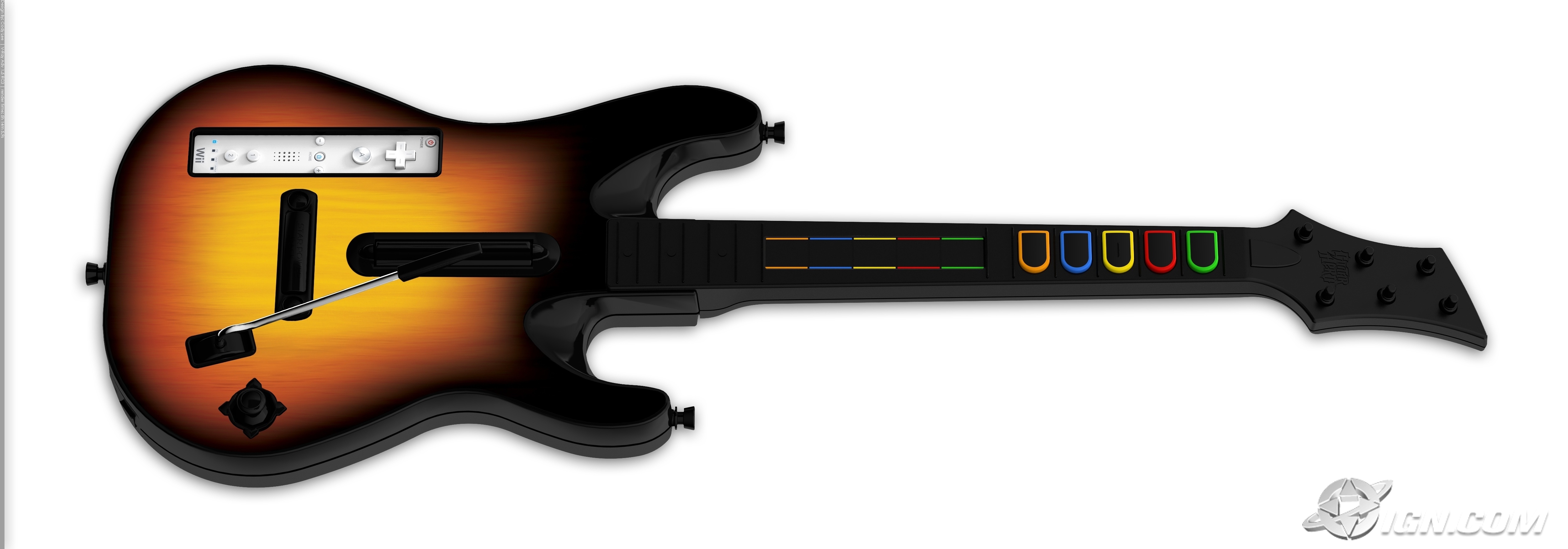
There are a bunch of guitar and drums devices out there that all report
similar data. To avoid reporting this as BTN_MISC or ABS_MISC, we
allocate some proper namespace for them. Note that most of these devices
are toys and we cannot report any sophisticated physics via this API.

I did some google-images research and tried to provide definitions that
work with all common devices. That's why I went with 4 toms, 4 cymbals,
one bass, one hi-hat. I haven't seen other drums and I doubt that we need
any additions to that. Anyway, the naming-scheme is intentionally done in
an extensible way.

For guitars, we support 5 frets (normally aligned vertically, compared to
the real horizontal layouts), a single strum-bar with up/down directions,
an optional fret-board and a whammy-bar.

Most of the devices provide pressure values so I went with ABS_* bits. If
we ever support devices which only provide digital input, we have to
decide whether to emulate pressure data or add additional BTN_* bits.

If someone is not familiar with these devices, here are two pictures which
provide almost all introduced interfaces (or try the given keywords
with a google-image search):
  Guitar: ("guitar hero world tour guitar")
    http://images1.wikia.nocookie.net/__cb20120911023442/applezone/es/images/f/f9/Wii_Guitar.jpg
  Drums: ("guitar hero drums")
    http://oyster.ignimgs.com/franchises/images/03/55/35526_band-hero-drum-set-hands-on-20090929040735768.jpg

Signed-off-by: David Herrmann <dh.herrmann@gmail.com>
Acked-by: Dmitry Torokhov <dmitry.torokhov@gmail.com>
Signed-off-by: Jiri Kosina <jkosina@suse.cz>
RFC 4443 has defined two additional codes for ICMPv6 type 1 (destination
unreachable) messages:
        5 - Source address failed ingress/egress policy
	6 - Reject route to destination

Now they are treated as protocol error and icmpv6_err_convert() converts them
to EPROTO.

RFC 4443 says:
	"Codes 5 and 6 are more informative subsets of code 1."

Treat codes 5 and 6 as code 1 (EACCES)

Btw, connect() returning -EPROTO confuses firefox, so that fallback to
other/IPv4 addresses does not work:
https://bugzilla.mozilla.org/show_bug.cgi?id=910773

Signed-off-by: Jiri Bohac <jbohac@suse.cz>
Acked-by: Hannes Frederic Sowa <hannes@stressinduktion.org>
Signed-off-by: David S. Miller <davem@davemloft.net>
Marc Kleine-Budde says:

====================
this is a pull request for net-next. There are two patches from Gerhard
Sittig, which improves the clock handling on mpc5121. Oliver Hartkopp
provides a patch that adds a per rule limitation of frame hops.
====================

Signed-off-by: David S. Miller <davem@davemloft.net>
John W. Linville says:

====================
Please accept this batch of updates intended for the 3.12 stream.

For the mac80211 bits, Johannes says this:

"This time I have various improvements all over the place: IBSS, mesh,
testmode, AP client powersave handling, one of the rare rfkill patches
and some code cleanup."

Also for mac80211:

"And I also have some more changes for -next, just a few small fixes and
improvements, nothing really stands out."

And for iwlwifi:

"This time I have some powersave work (notably uAPSD support), CQM
offloads, support for a new firmware API and various code cleanups."

Regarding the Bluetooth bits, Gustavo says:

"Patches to 3.12, here we have:

* implementation of a proper tty_port for RFCOMM devices, this fixes some
issues people were seeing lately in the kernel.
* Add voice_setting option for SCO, it is used for SCO Codec selection
* bugfixes, small improvements and clean ups"

For the NFC bits, Samuel says:

"With this one we have:

- A few pn533 improvements and minor fixes. Testing our pn533 driver
  against Google's NCI stack triggered a few issues that we fixed now.
  We also added Tx fragmentation support to this driver.

- More NFC secure element handling. We added a GET_SE netlink command
  for getting all the discovered secure elements, and we defined 2
  additional secure element netlink event (transaction and connectivity).
  We also fixed a couple of typos and copy-paste bugs from the secure
  element handling code.

- Firmware download support for the pn544 driver. This chipset can enter a
  special mode where it's waiting for firmware blobs to replace the
  already flashed one. We now support that mode."

With repect to the ath tree, Kalle says:

"New features in ath10k are rx/tx checsumming in hw and survey scan
implemented by Michal. Also he made fixes to different areas of the
driver, most notable being fixing the case when using two streams and
reducing the number of interface combinations to avoid firmware crashes.
Bartosz did a clean related to how we handle SoC power save in PCI
layer.

For ath6kl Mohammed and Vasanth sent each a patch to fix two infrequent
crashes."

I also pulled the wireless tree into wireless-next to support a
request from Johannes.  On top of all that, there are the usual
sort of driver updates.  The mwifiex, brcmfmac, brcmsmac, ath9k,
and rt2x00 drivers all get some attention, as does the bcma bus and
a few other random bits here and there.
====================

Signed-off-by: David S. Miller <davem@davemloft.net>
To build user programs that call the NVMe ioctls, we need to have a
user header file.  Catch up to the new way of doing that by splitting
the header file into kernel and uapi portions.

Signed-off-by: Matthew Wilcox <matthew.r.wilcox@intel.com>
Here's the big tty/serial driver pull request for 3.12-rc1.

 Lots of n_tty reworks to resolve some very long-standing issues, removing the
 3-4 different locks that were taken for every character.  This code has been
 beaten on for a long time in linux-next with no reported regressions.

 Other than that, a range of serial and tty driver updates and revisions.  Full
 details in the shortlog.

 Signed-off-by: Greg Kroah-Hartman <gregkh@linuxfoundation.org>
 -----BEGIN PGP SIGNATURE-----
 Version: GnuPG v2.0.21 (GNU/Linux)

 iEYEABECAAYFAlIlI6UACgkQMUfUDdst+ym7kgCgmysv/TVeqsdvmkiO2eEB4+xs
 ddwAoMqkJ/enCJ2f+fC8y2Wz+5+kDrU7
 =CiCp
 -----END PGP SIGNATURE-----

Merge tag 'tty-3.12-rc1' of git://git.kernel.org/pub/scm/linux/kernel/git/gregkh/tty

Pull tty/serial driver patches from Greg KH:
 "Here's the big tty/serial driver pull request for 3.12-rc1.

  Lots of n_tty reworks to resolve some very long-standing issues,
  removing the 3-4 different locks that were taken for every character.
  This code has been beaten on for a long time in linux-next with no
  reported regressions.

  Other than that, a range of serial and tty driver updates and
  revisions.  Full details in the shortlog"

* tag 'tty-3.12-rc1' of git://git.kernel.org/pub/scm/linux/kernel/git/gregkh/tty: (226 commits)
  hvc_xen: Remove unnecessary __GFP_ZERO from kzalloc
  serial: imx: initialize the local variable
  tty: ar933x_uart: add device tree support and binding documentation
  tty: ar933x_uart: allow to build the driver as a module
  ARM: dts: msm: Update uartdm compatible strings
  devicetree: serial: Document msm_serial bindings
  serial: unify serial bindings into a single dir
  serial: fsl-imx-uart: Cleanup duplicate device tree binding
  tty: ar933x_uart: use config_enabled() macro to clean up ifdefs
  tty: ar933x_uart: remove superfluous assignment of ar933x_uart_driver.nr
  tty: ar933x_uart: use the clk API to get the uart clock
  tty: serial: cpm_uart: Adding proper request of GPIO used by cpm_uart driver
  serial: sirf: fix the amount of serial ports
  serial: sirf: define macro for some magic numbers of USP
  serial: icom: move array overflow checks earlier
  TTY: amiserial, remove unnecessary platform_set_drvdata()
  serial: st-asc: remove unnecessary platform_set_drvdata()
  msm_serial: Send more than 1 character on the console w/ UARTDM
  msm_serial: Add support for non-GSBI UARTDM devices
  msm_serial: Switch clock consumer strings and simplify code
  ...
When an event is disabled the "tracking" events selected by the 'mmap',
'comm' and 'task' bits of struct perf_event_attr, are also disabled.
However, the information those events provide is necessary to resolve
symbols for when the main event is re-enabled.

The "tracking" events can be kept enabled by putting them on another
event, but that requires an event that otherwise does nothing.  A new
software event PERF_COUNT_SW_DUMMY is added for that purpose.

Signed-off-by: Adrian Hunter <adrian.hunter@intel.com>
Acked-by: Peter Zijlstra <peterz@infradead.org>
Cc: David Ahern <dsahern@gmail.com>
Cc: Frederic Weisbecker <fweisbec@gmail.com>
Cc: Ingo Molnar <mingo@redhat.com>
Cc: Jiri Olsa <jolsa@redhat.com>
Cc: Mike Galbraith <efault@gmx.de>
Cc: Namhyung Kim <namhyung@gmail.com>
Cc: Paul Mackerras <paulus@samba.org>
Cc: Peter Zijlstra <a.p.zijlstra@chello.nl>
Cc: Stephane Eranian <eranian@google.com>
Link: http://lkml.kernel.org/r/1377975053-3811-2-git-send-email-adrian.hunter@intel.com
Signed-off-by: Arnaldo Carvalho de Melo <acme@redhat.com>
If PERF_SAMPLE_BRANCH_STACK is enabled then samples are returned
with the format { u64 from, to, flags } but the flags layout
is not specified.

This field has the type struct perf_branch_entry; move this
definition into include/uapi/linux/perf_event.h so users can
access these fields.

This is similar to the existing inclusion of perf_mem_data_src in
the include/uapi/linux/perf_event.h file.

Signed-off-by: Vince Weaver <vincent.weaver@maine.edu>
Acked-by: Stephane Eranian <eranian@google.com>
Signed-off-by: Peter Zijlstra <peterz@infradead.org>
Link: http://lkml.kernel.org/r/alpine.DEB.2.10.1308231544420.1889@vincent-weaver-1.um.maine.edu
Signed-off-by: Ingo Molnar <mingo@kernel.org>
Adds a new PERF_RECORD_MMAP2 record type which is essence
an expanded version of PERF_RECORD_MMAP.

Used to request mmap records with more information about
the mapping, including device major, minor and the inode
number and generation for mappings associated with files
or shared memory segments. Works for code and data
(with attr->mmap_data set).

Existing PERF_RECORD_MMAP record is unmodified by this patch.

Signed-off-by: Stephane Eranian <eranian@google.com>
Signed-off-by: Peter Zijlstra <peterz@infradead.org>
Cc: Al Viro <viro@zeniv.linux.org.uk>
Link: http://lkml.kernel.org/r/1377079825-19057-2-git-send-email-eranian@google.com
[ Added Al to the Cc:. Are the ino, maj/min exports of vma->vm_file OK? ]
Signed-off-by: Ingo Molnar <mingo@kernel.org>
Signed-off-by: Mike Frysinger <vapier@gentoo.org>
Signed-off-by: Josef Bacik <jbacik@fusionio.com>
Signed-off-by: Chris Mason <chris.mason@fusionio.com>
This patch adds an ioctl, BTRFS_IOC_FILE_EXTENT_SAME which will try to
de-duplicate a list of extents across a range of files.

Internally, the ioctl re-uses code from the clone ioctl. This avoids
rewriting a large chunk of extent handling code.

Userspace passes in an array of file, offset pairs along with a length
argument. The ioctl will then (for each dedupe) do a byte-by-byte comparison
of the user data before deduping the extent. Status and number of bytes
deduped are returned for each operation.

Signed-off-by: Mark Fasheh <mfasheh@suse.de>
Reviewed-by: Zach Brown <zab@redhat.com>
Signed-off-by: Josef Bacik <jbacik@fusionio.com>
Signed-off-by: Chris Mason <chris.mason@fusionio.com>
This patch adds IPv6 support to vxlan device, as the new version
RFC already mentions it:

   http://tools.ietf.org/html/draft-mahalingam-dutt-dcops-vxlan-03

Cc: David Stevens <dlstevens@us.ibm.com>
Cc: Stephen Hemminger <stephen@networkplumber.org>
Cc: David S. Miller <davem@davemloft.net>
Signed-off-by: Cong Wang <amwang@redhat.com>
Signed-off-by: David S. Miller <davem@davemloft.net>
- Uses perfect flow match (not stochastic hash like SFQ/FQ_codel)
- Uses the new_flow/old_flow separation from FQ_codel
- New flows get an initial credit allowing IW10 without added delay.
- Special FIFO queue for high prio packets (no need for PRIO + FQ)
- Uses a hash table of RB trees to locate the flows at enqueue() time
- Smart on demand gc (at enqueue() time, RB tree lookup evicts old
  unused flows)
- Dynamic memory allocations.
- Designed to allow millions of concurrent flows per Qdisc.
- Small memory footprint : ~8K per Qdisc, and 104 bytes per flow.
- Single high resolution timer for throttled flows (if any).
- One RB tree to link throttled flows.
- Ability to have a max rate per flow. We might add a socket option
  to add per socket limitation.

Attempts have been made to add TCP pacing in TCP stack, but this
seems to add complex code to an already complex stack.

TCP pacing is welcomed for flows having idle times, as the cwnd
permits TCP stack to queue a possibly large number of packets.

This removes the 'slow start after idle' choice, hitting badly
large BDP flows, and applications delivering chunks of data
as video streams.

Nicely spaced packets :
Here interface is 10Gbit, but flow bottleneck is ~20Mbit

cwin is big, yet FQ avoids the typical bursts generated by TCP
(as in netperf TCP_RR -- -r 100000,100000)

15:01:23.545279 IP A > B: . 78193:81089(2896) ack 65248 win 3125 <nop,nop,timestamp 1115 11597805>
15:01:23.545394 IP B > A: . ack 81089 win 3668 <nop,nop,timestamp 11597985 1115>
15:01:23.546488 IP A > B: . 81089:83985(2896) ack 65248 win 3125 <nop,nop,timestamp 1115 11597805>
15:01:23.546565 IP B > A: . ack 83985 win 3668 <nop,nop,timestamp 11597986 1115>
15:01:23.547713 IP A > B: . 83985:86881(2896) ack 65248 win 3125 <nop,nop,timestamp 1115 11597805>
15:01:23.547778 IP B > A: . ack 86881 win 3668 <nop,nop,timestamp 11597987 1115>
15:01:23.548911 IP A > B: . 86881:89777(2896) ack 65248 win 3125 <nop,nop,timestamp 1115 11597805>
15:01:23.548949 IP B > A: . ack 89777 win 3668 <nop,nop,timestamp 11597988 1115>
15:01:23.550116 IP A > B: . 89777:92673(2896) ack 65248 win 3125 <nop,nop,timestamp 1115 11597805>
15:01:23.550182 IP B > A: . ack 92673 win 3668 <nop,nop,timestamp 11597989 1115>
15:01:23.551333 IP A > B: . 92673:95569(2896) ack 65248 win 3125 <nop,nop,timestamp 1115 11597805>
15:01:23.551406 IP B > A: . ack 95569 win 3668 <nop,nop,timestamp 11597991 1115>
15:01:23.552539 IP A > B: . 95569:98465(2896) ack 65248 win 3125 <nop,nop,timestamp 1115 11597805>
15:01:23.552576 IP B > A: . ack 98465 win 3668 <nop,nop,timestamp 11597992 1115>
15:01:23.553756 IP A > B: . 98465:99913(1448) ack 65248 win 3125 <nop,nop,timestamp 1115 11597805>
15:01:23.554138 IP A > B: P 99913:100001(88) ack 65248 win 3125 <nop,nop,timestamp 1115 11597805>
15:01:23.554204 IP B > A: . ack 100001 win 3668 <nop,nop,timestamp 11597993 1115>
15:01:23.554234 IP B > A: . 65248:68144(2896) ack 100001 win 3668 <nop,nop,timestamp 11597993 1115>
15:01:23.555620 IP B > A: . 68144:71040(2896) ack 100001 win 3668 <nop,nop,timestamp 11597993 1115>
15:01:23.557005 IP B > A: . 71040:73936(2896) ack 100001 win 3668 <nop,nop,timestamp 11597993 1115>
15:01:23.558390 IP B > A: . 73936:76832(2896) ack 100001 win 3668 <nop,nop,timestamp 11597993 1115>
15:01:23.559773 IP B > A: . 76832:79728(2896) ack 100001 win 3668 <nop,nop,timestamp 11597993 1115>
15:01:23.561158 IP B > A: . 79728:82624(2896) ack 100001 win 3668 <nop,nop,timestamp 11597994 1115>
15:01:23.562543 IP B > A: . 82624:85520(2896) ack 100001 win 3668 <nop,nop,timestamp 11597994 1115>
15:01:23.563928 IP B > A: . 85520:88416(2896) ack 100001 win 3668 <nop,nop,timestamp 11597994 1115>
15:01:23.565313 IP B > A: . 88416:91312(2896) ack 100001 win 3668 <nop,nop,timestamp 11597994 1115>
15:01:23.566698 IP B > A: . 91312:94208(2896) ack 100001 win 3668 <nop,nop,timestamp 11597994 1115>
15:01:23.568083 IP B > A: . 94208:97104(2896) ack 100001 win 3668 <nop,nop,timestamp 11597994 1115>
15:01:23.569467 IP B > A: . 97104:100000(2896) ack 100001 win 3668 <nop,nop,timestamp 11597994 1115>
15:01:23.570852 IP B > A: . 100000:102896(2896) ack 100001 win 3668 <nop,nop,timestamp 11597994 1115>
15:01:23.572237 IP B > A: . 102896:105792(2896) ack 100001 win 3668 <nop,nop,timestamp 11597994 1115>
15:01:23.573639 IP B > A: . 105792:108688(2896) ack 100001 win 3668 <nop,nop,timestamp 11597994 1115>
15:01:23.575024 IP B > A: . 108688:111584(2896) ack 100001 win 3668 <nop,nop,timestamp 11597994 1115>
15:01:23.576408 IP B > A: . 111584:114480(2896) ack 100001 win 3668 <nop,nop,timestamp 11597994 1115>
15:01:23.577793 IP B > A: . 114480:117376(2896) ack 100001 win 3668 <nop,nop,timestamp 11597994 1115>

TCP timestamps show that most packets from B were queued in the same ms
timeframe (TSval 1159799{3,4}), but FQ managed to send them right
in time to avoid a big burst.

In slow start or steady state, very few packets are throttled [1]

FQ gets a bunch of tunables as :

  limit : max number of packets on whole Qdisc (default 10000)

  flow_limit : max number of packets per flow (default 100)

  quantum : the credit per RR round (default is 2 MTU)

  initial_quantum : initial credit for new flows (default is 10 MTU)

  maxrate : max per flow rate (default : unlimited)

  buckets : number of RB trees (default : 1024) in hash table.
               (consumes 8 bytes per bucket)

  [no]pacing : disable/enable pacing (default is enable)

All of them can be changed on a live qdisc.

$ tc qd add dev eth0 root fq help
Usage: ... fq [ limit PACKETS ] [ flow_limit PACKETS ]
              [ quantum BYTES ] [ initial_quantum BYTES ]
              [ maxrate RATE  ] [ buckets NUMBER ]
              [ [no]pacing ]

$ tc -s -d qd
qdisc fq 8002: dev eth0 root refcnt 32 limit 10000p flow_limit 100p buckets 256 quantum 3028 initial_quantum 15140
 Sent 216532416 bytes 148395 pkt (dropped 0, overlimits 0 requeues 14)
 backlog 0b 0p requeues 14
  511 flows, 511 inactive, 0 throttled
  110 gc, 0 highprio, 0 retrans, 1143 throttled, 0 flows_plimit

[1] Except if initial srtt is overestimated, as if using
cached srtt in tcp metrics. We'll provide a fix for this issue.

Signed-off-by: Eric Dumazet <edumazet@google.com>
Cc: Yuchung Cheng <ycheng@google.com>
Cc: Neal Cardwell <ncardwell@google.com>
Signed-off-by: David S. Miller <davem@davemloft.net>
Usually the received CAN frames can be processed/routed as much as 'max_hops'
times (which is given at module load time of the can-gw module).
Introduce a new configuration option to reduce the number of possible hops
for a specific gateway rule to a value smaller then max_hops.

Signed-off-by: Oliver Hartkopp <socketcan@hartkopp.net>
Signed-off-by: Marc Kleine-Budde <mkl@pengutronix.de>
We currently allow for different fanout scheduling policies in pf_packet
such as scheduling by skb's rxhash, round-robin, by cpu, and rollover.
Also allow for a random, equidistributed selection of the socket from the
fanout process group.

Signed-off-by: Daniel Borkmann <dborkman@redhat.com>
Signed-off-by: David S. Miller <davem@davemloft.net>
This patch implements RFC6980: Drop fragmented ndisc packets by
default. If a fragmented ndisc packet is received the user is informed
that it is possible to disable the check.

Cc: Fernando Gont <fernando@gont.com.ar>
Cc: YOSHIFUJI Hideaki <yoshfuji@linux-ipv6.org>
Signed-off-by: Hannes Frederic Sowa <hannes@stressinduktion.org>
Signed-off-by: David S. Miller <davem@davemloft.net>
The event stream is not always parsable because the format of a sample
is dependent on the sample_type of the selected event.  When there is
more than one selected event and the sample_types are not the same then
parsing becomes problematic.  A sample can be matched to its selected
event using the ID that is allocated when the event is opened.
Unfortunately, to get the ID from the sample means first parsing it.

This patch adds a new sample format bit PERF_SAMPLE_IDENTIFER that puts
the ID at a fixed position so that the ID can be retrieved without
parsing the sample.  For sample events, that is the first position
immediately after the header.  For non-sample events, that is the last
position.

In this respect parsing samples requires that the sample_type and ID
values are recorded.  For example, perf tools records struct
perf_event_attr and the IDs within the perf.data file.  Those must be
read first before it is possible to parse samples found later in the
perf.data file.

Signed-off-by: Adrian Hunter <adrian.hunter@intel.com>
Tested-by: Stephane Eranian <eranian@google.com>
Acked-by: Peter Zijlstra <peterz@infradead.org>
Cc: David Ahern <dsahern@gmail.com>
Cc: Frederic Weisbecker <fweisbec@gmail.com>
Cc: Ingo Molnar <mingo@kernel.org>
Cc: Jiri Olsa <jolsa@redhat.com>
Cc: Mike Galbraith <efault@gmx.de>
Cc: Namhyung Kim <namhyung@gmail.com>
Cc: Paul Mackerras <paulus@samba.org>
Cc: Peter Zijlstra <peterz@infradead.org>
Cc: Stephane Eranian <eranian@google.com>
Link: http://lkml.kernel.org/r/1377591794-30553-6-git-send-email-adrian.hunter@intel.com
Signed-off-by: Arnaldo Carvalho de Melo <acme@redhat.com>
SYN_* events are special and not enabled via set_bit() for devices. Hence,
they haven't been really needed, yet. However, user-space can still make
great use of that for int->string debugging helpers or alike.
Also, I haven't seen any reason not to define these, so here they are.
Signed-off-by: David Herrmann <dh.herrmann@gmail.com>
Acked-by: Peter Hutterer <peter.hutterer@who-t.net>
Signed-off-by: Dmitry Torokhov <dmitry.torokhov@gmail.com>
This file uses the ioctl helpers (_IOR/_IOW/etc...), so include ioctl.h
for the definitions.
Signed-off-by: Mike Frysinger <vapier@gentoo.org>
Cc: Harald Welte <laforge@gnumonks.org>
Signed-off-by: Andrew Morton <akpm@linux-foundation.org>
Signed-off-by: Linus Torvalds <torvalds@linux-foundation.org>
These offsets are not used, and in some cases are completely reserved
even in the spec, but I'm adding them for completeness just to match
the diagrams in the spec, e.g., PCIe spec r3.0, sec 7.8.
Signed-off-by: Bjorn Helgaas <bhelgaas@google.com>
The convention of showing bits in a mask of the full register width, e.g.,
"0x00000007" instead of "0x07" for a field in a 32-bit register, is common
but not universal in this file. This patch makes it consistently used at
least for the PCIe capability.
Whitespace and zero-extension changes only; no functional change.
Signed-off-by: Bjorn Helgaas <bhelgaas@google.com>
pci_pcie_cap2() was replaced by pcie_capability_read_word() and similar
functions, so update the comment.
Signed-off-by: Bjorn Helgaas <bhelgaas@google.com>
The PCI_EXP_TYPE_PCI_BRIDGE is a *PCIe* function that is a bridge to
PCI/PCI-X. See PCIe spec r3.0, sec 7.8.2.
Signed-off-by: Bjorn Helgaas <bhelgaas@google.com>
Jesse Gross says:
====================
A number of significant new features and optimizations for net-next/3.12.
Highlights are:
* "Megaflows", an optimization that allows userspace to specify which
flow fields were used to compute the results of the flow lookup.
This allows for a major reduction in flow setups (the major
performance bottleneck in Open vSwitch) without reducing flexibility.
* Converting netlink dump operations to use RCU, allowing for
additional parallelism in userspace.
* Matching and modifying SCTP protocol fields.
====================
Signed-off-by: David S. Miller <davem@davemloft.net>
This reverts commit c441508421.
Kevin writes:
Hmm, another OMAP serial patch that wasn't Cc'd to linux-omap
where OMAP users might have seen it. :(
I just bisected a strange problem in linux-next on OMAP3 down to
this patch. Reverting it fixes the problem.
On OMAP3530 Beagle and Overo, after boot, doing a 'cat
/proc/cpuinfo' was not returning to a prompt, suggesting
something strange with the FIFO. Hitting return gets me back to
a prompt.
Greg, this one should also be dropped from tty-next until it can
be further investgated and the problem solved.
Reported-by: Kevin Hilman <khilman@linaro.org>
Cc: Dmitry Fink <finik@ti.com>
Cc: Alexander Savchenko <oleksandr.savchenko@ti.com>
Signed-off-by: Greg Kroah-Hartman <gregkh@linuxfoundation.org>
Add a SYNPROXY for netfilter. The code is split into two parts, the synproxy
core with common functions and an address family specific target.
The SYNPROXY receives the connection request from the client, responds with
a SYN/ACK containing a SYN cookie and announcing a zero window and checks
whether the final ACK from the client contains a valid cookie.
It then establishes a connection to the original destination and, if
successful, sends a window update to the client with the window size
announced by the server.
Support for timestamps, SACK, window scaling and MSS options can be
statically configured as target parameters if the features of the server
are known. If timestamps are used, the timestamp value sent back to
the client in the SYN/ACK will be different from the real timestamp of
the server. In order to now break PAWS, the timestamps are translated in
the direction server->client.
Signed-off-by: Patrick McHardy <kaber@trash.net>
Tested-by: Martin Topholm <mph@one.com>
Signed-off-by: Jesper Dangaard Brouer <brouer@redhat.com>
Signed-off-by: Pablo Neira Ayuso <pablo@netfilter.org>
Split out sequence number adjustments from NAT and move them to the conntrack
core to make them usable for SYN proxying. The sequence number adjustment
information is moved to a seperate extend. The extend is added to new
conntracks when a NAT mapping is set up for a connection using a helper.
As a side effect, this saves 24 bytes per connection with NAT in the common
case that a connection does not have a helper assigned.
Signed-off-by: Patrick McHardy <kaber@trash.net>
Tested-by: Martin Topholm <mph@one.com>
Signed-off-by: Jesper Dangaard Brouer <brouer@redhat.com>
Signed-off-by: Pablo Neira Ayuso <pablo@netfilter.org>
All other PCIe capability register fields include "PCI_EXP" + <reg-name> +
<field-name>. This renames PCI_EXP_OBFF_MASK, PCI_EXP_IDO_REQ_EN,
PCI_EXP_LTR_EN, and related fields using the same convention.
No functional change.
Signed-off-by: Bjorn Helgaas <bhelgaas@google.com>
Acked-by: Samuel Ortiz <sameo@linux.intel.com> # for MFD driver
This patch adds support for rewriting SCTP src,dst ports similar to the
functionality already available for TCP/UDP.
Rewriting SCTP ports is expensive due to double-recalculation of the
SCTP checksums; this is performed to ensure that packets traversing OVS
with invalid checksums will continue to the destination with any
checksum corruption intact.
Reviewed-by: Simon Horman <horms@verge.net.au>
Signed-off-by: Joe Stringer <joe@wand.net.nz>
Signed-off-by: Ben Pfaff <blp@nicira.com>
Signed-off-by: Jesse Gross <jesse@nicira.com>
Conflicts:
	drivers/net/wireless/iwlwifi/pcie/trans.c
include/linux/inetdevice.h
The inetdevice.h conflict involves moving the IPV4_DEVCONF values
into a UAPI header, overlapping additions of some new entries.
The iwlwifi conflict is a context overlap.
Signed-off-by: David S. Miller <davem@davemloft.net>
This is to reserve a capablity number for upcoming support
of H_PUT_TCE_INDIRECT and H_STUFF_TCE pseries hypercalls
which support mulptiple DMA map/unmap operations per one call.

Signed-off-by: Alexey Kardashevskiy <aik@ozlabs.ru>
Signed-off-by: Gleb Natapov <gleb@redhat.com>
this is needed by both guest and host.

Originally-from: Srivatsa Vaddagiri <vatsa@linux.vnet.ibm.com>
Signed-off-by: Raghavendra K T <raghavendra.kt@linux.vnet.ibm.com>
Acked-by: Gleb Natapov <gleb@redhat.com>
Acked-by: Ingo Molnar <mingo@kernel.org>
Signed-off-by: Gleb Natapov <gleb@redhat.com>
Add wildcarded flow support in kernel datapath.

Wildcarded flow can improve OVS flow set up performance by avoid sending
matching new flows to the user space program. The exact performance boost
will largely dependent on wildcarded flow hit rate.

In case all new flows hits wildcard flows, the flow set up rate is
within 5% of that of linux bridge module.

Pravin has made significant contributions to this patch. Including API
clean ups and bug fixes.

Signed-off-by: Pravin B Shelar <pshelar@nicira.com>
Signed-off-by: Andy Zhou <azhou@nicira.com>
Signed-off-by: Jesse Gross <jesse@nicira.com>
Add flags intended to report various auxiliary information
and introduce the NL80211_RXMGMT_FLAG_ANSWERED flag to report
that the frame was already answered by the device.

Signed-off-by: Vladimir Kondratiev <qca_vkondrat@qca.qualcomm.com>
[REPLIED->ANSWERED, reword commit message]
Signed-off-by: Johannes Berg <johannes.berg@intel.com>
IP sends device configuration (see inet_fill_link_af) as an array
in the netlink information, but the indices in that array are not
exposed to userspace through any current santized header file.

It was available back in 2.6.32 (in /usr/include/linux/sysctl.h)
but was broken by:
  commit 02291680ff
  Author: Eric W. Biederman <ebiederm@xmission.com>
  Date:   Sun Feb 14 03:25:51 2010 +0000

    net ipv4: Decouple ipv4 interface parameters from binary sysctl numbers

Eric was solving the sysctl problem but then the indices were re-exposed
by a later addition of devconf support for IPV4

  commit 9f0f7272ac
  Author: Thomas Graf <tgraf@infradead.org>
  Date:   Tue Nov 16 04:32:48 2010 +0000

    ipv4: AF_INET link address family

Putting them in /usr/include/linux/ip.h seemed the logical match
for the DEVCONF_ definitions for IPV6 in /usr/include/linux/ip6.h

Signed-off-by: Stephen Hemminger <stephen@networkplumber.org>
Signed-off-by: David S. Miller <davem@davemloft.net>
The only thing we may have from tun device is the fprog, whic contains
the number of filter elements and a pointer to (user-space) memory
where the elements are. The program itself may not be available if the
device is persistent and detached.

Signed-off-by: Pavel Emelyanov <xemul@parallels.com>
Signed-off-by: David S. Miller <davem@davemloft.net>
There's a small problem with sk-filters on tun devices. Consider
an application doing this sequence of steps:

fd = open("/dev/net/tun");
ioctl(fd, TUNSETIFF, { .ifr_name = "tun0" });
ioctl(fd, TUNATTACHFILTER, &my_filter);
ioctl(fd, TUNSETPERSIST, 1);
close(fd);

At that point the tun0 will remain in the system and will keep in
mind that there should be a socket filter at address '&my_filter'.

If after that we do

fd = open("/dev/net/tun");
ioctl(fd, TUNSETIFF, { .ifr_name = "tun0" });

we most likely receive the -EFAULT error, since tun_attach() would
try to connect the filter back. But (!) if we provide a filter at
address &my_filter, then tun0 will be created and the "new" filter
would be attached, but application may not know about that.

This may create certain problems to anyone using tun-s, but it's
critical problem for c/r -- if we meet a persistent tun device
with a filter in mind, we will not be able to attach to it to dump
its state (flags, owner, address, vnethdr size, etc.).

The proposal is to allow to attach to tun device (with TUNSETIFF)
w/o attaching the filter to the tun-file's socket. After this
attach app may e.g clean the device by dropping the filter, it
doesn't want to have one, or (in case of c/r) get information
about the device with tun ioctls.

Signed-off-by: Pavel Emelyanov <xemul@parallels.com>
Signed-off-by: David S. Miller <davem@davemloft.net>
Tun devices cannot be created with ifidex user wants, but it's
required by checkpoint-restore project.

Long time ago such ability was implemented for rtnl_ops-based
interface for creating links (9c7dafbf net: Allow to create links
with given ifindex), but the only API for creating and managing
tuntap devices is ioctl-based and is evolving with adding new ones
(cde8b15f tuntap: add ioctl to attach or detach a file form tuntap
device).

Following that trend, here's how a new ioctl that sets the ifindex
for device, that _will_ be created by TUNSETIFF ioctl looks like.
So those who want a tuntap device with the ifindex N, should open
the tun device, call ioctl(fd, TUNSETIFINDEX, &N), then call TUNSETIFF.
If the index N is busy, then the register_netdev will find this out
and the ioctl would be failed with -EBUSY.

If setifindex is not called, then it will be generated as before.

Signed-off-by: Pavel Emelyanov <xemul@parallels.com>
Signed-off-by: David S. Miller <davem@davemloft.net>
XFS now supports three types of quotas (user, group and project).

Current version of Q_XGETSTAT has support for only two types of quotas.
In order to support three types of quotas, the interface, specifically
struct fs_quota_stat, need to be expanded. Current version of fs_quota_stat
does not allow expansion without breaking backward compatibility.

So, a quotactl command and new fs_quota_stat structure need to be added.

This patch adds a new command Q_XGETQSTATV to quotactl() which takes
a new data structure fs_quota_statv. This new data structure provides
support for future expansion and backward compatibility.

Callers of the new quotactl command have to set the version of the data
structure being passed, and kernel will fill as much data as requested.
If the kernel does not support the user-space provided version, EINVAL
will be returned. User-space can reduce the version number and call the same
quotactl again.

Signed-off-by: Chandra Seetharaman <sekharan@us.ibm.com>
Reviewed-by: Jan Kara <jack@suse.cz>
Reviewed-by: Rich Johnston <rjohnston@sgi.com>
Signed-off-by: Ben Myers <bpm@sgi.com>

[v2: Applied rjohnston's suggestions as per Chandra's request. -bpm]
Conflicts:
	net/netfilter/nf_conntrack_proto_tcp.c

The conflict had to do with overlapping changes dealing with
fixing the use of an "s32" to hold the value returned by
NAT_OFFSET().

Pablo Neira Ayuso says:

====================
The following batch contains Netfilter/IPVS updates for your net-next tree.
More specifically, they are:

* Trivial typo fix in xt_addrtype, from Phil Oester.

* Remove net_ratelimit in the conntrack logging for consistency with other
  logging subsystem, from Patrick McHardy.

* Remove unneeded includes from the recently added xt_connlabel support, from
  Florian Westphal.

* Allow to update conntracks via nfqueue, don't need NFQA_CFG_F_CONNTRACK for
  this, from Florian Westphal.

* Remove tproxy core, now that we have socket early demux, from Florian
  Westphal.

* A couple of patches to refactor conntrack event reporting to save a good
  bunch of lines, from Florian Westphal.

* Fix missing locking in NAT sequence adjustment, it did not manifested in
  any known bug so far, from Patrick McHardy.

* Change sequence number adjustment variable to 32 bits, to delay the
  possible early overflow in long standing connections, also from Patrick.

* Comestic cleanups for IPVS, from Dragos Foianu.

* Fix possible null dereference in IPVS in the SH scheduler, from Daniel
  Borkmann.

* Allow to attach conntrack expectations via nfqueue. Before this patch, you
  had to use ctnetlink instead, thus, we save the conntrack lookup.

* Export xt_rpfilter and xt_HMARK header files, from Nicolas Dichtel.
====================

Signed-off-by: David S. Miller <davem@davemloft.net>
Following patch adds vxlan vport type for openvswitch using
vxlan api. So now there is vxlan dependency for openvswitch.

CC: Jesse Gross <jesse@nicira.com>
Signed-off-by: Pravin B Shelar <pshelar@nicira.com>
Acked-by: Jesse Gross <jesse@nicira.com>
Signed-off-by: David S. Miller <davem@davemloft.net>
It is very common to have to calculate the total width and height of the
blanking and the full frame, so add a few defines that deal with that.

Signed-off-by: Hans Verkuil <hans.verkuil@cisco.com>
Acked-by: Lad, Prabhakar <prabhakar.csengg@gmail.com>
Signed-off-by: Mauro Carvalho Chehab <m.chehab@samsung.com>
This particular DMT timing definition was duplicated in the header.

Signed-off-by: Hans Verkuil <hans.verkuil@cisco.com>
Signed-off-by: Mauro Carvalho Chehab <m.chehab@samsung.com>